
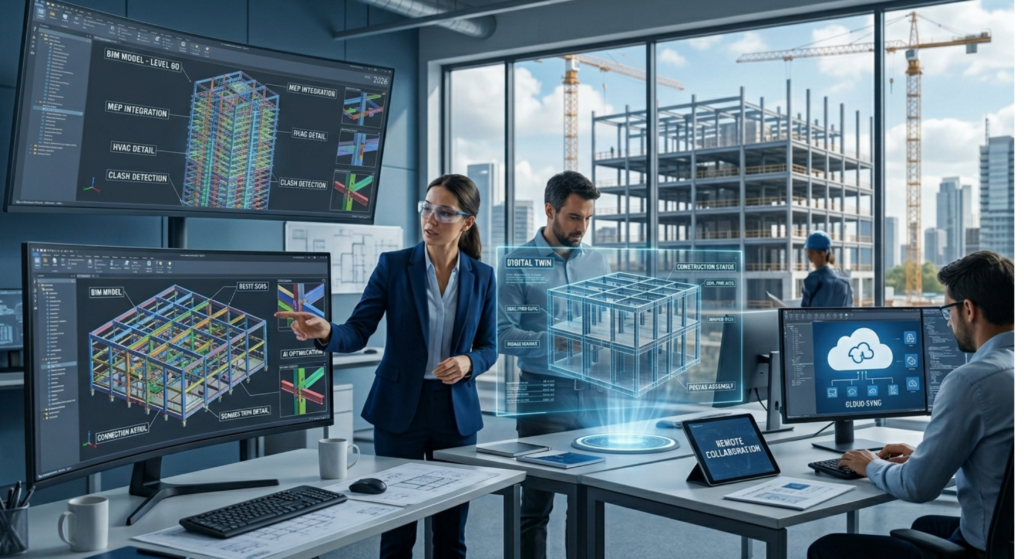
The structural steel industry is rapidly evolving with the adoption of advanced technologies, digital workflows, and smarter project management practices. As construction projects become larger and more complex, structural steel detailing plays a crucial role in ensuring accuracy, efficiency, and seamless coordination among stakeholders.
Here are the latest trends shaping the future of structural steel detailing in 2026.
1. Building Information Modeling (BIM) Integration
Building Information Modeling (BIM) has become a standard practice in modern steel construction. BIM enables engineers, fabricators, architects, and contractors to collaborate through a shared 3D model, improving communication and reducing errors.
Benefits of BIM in Steel Detailing:
- Enhanced visualization of structures
- Better clash detection and coordination
- Reduced rework and project delays
- Improved accuracy in fabrication drawings
- Efficient project management
2. Increased Adoption of Tekla Structures
Tekla Structures continues to be one of the most preferred software solutions for structural steel detailing. Its advanced modeling capabilities allow detailers to create highly accurate and constructible models.
Why Tekla Structures is Trending:
- Precise steel connection detailing
- Automated drawing generation
- Improved collaboration with BIM workflows
- Better material and quantity management
- Faster project delivery
3. Automation and Artificial Intelligence (AI)
Automation tools and AI-powered features are transforming traditional detailing processes. Modern software can automatically generate repetitive components, detect clashes, and optimize workflows.
Advantages:
- Reduced manual effort
- Increased productivity
- Faster detailing cycles
- Minimized human errors
- Consistent quality standards
4. Cloud-Based Collaboration
Remote working and global project teams have accelerated the use of cloud platforms. Teams can now access models, drawings, and project data from anywhere in real time.
Key Benefits:
- Improved team collaboration
- Instant design updates
- Better version control
- Secure data sharing
- Increased project transparency
5. 3D Visualization and Virtual Construction
Advanced 3D visualization tools help clients and construction teams understand complex structures before fabrication begins. Virtual construction techniques reduce uncertainties and improve decision-making.
Applications:
- Project presentations
- Construction sequencing
- Design validation
- Conflict resolution
- Site planning
6. Focus on Sustainable Construction
Sustainability has become a major priority in the construction industry. Steel detailers are increasingly working with optimized designs that reduce material waste and support environmentally responsible construction practices.
Sustainable Practices Include:
- Efficient material utilization
- Waste reduction strategies
- Recyclable steel components
- Energy-efficient design approaches
- Optimized fabrication processes
7. Digital Fabrication and CNC Integration
Modern fabrication shops rely heavily on CNC machines and automated production systems. Accurate steel detailing models can directly generate fabrication data, improving manufacturing efficiency.
Benefits:
- Faster fabrication
- Reduced production errors
- Better quality control
- Improved resource utilization
- Seamless shop floor integration
8. Demand for Skilled Steel Detailers
As technology advances, the industry requires professionals who are proficient in software such as Tekla Structures, AutoCAD, and BIM workflows. Companies are increasingly seeking detailers with practical knowledge and digital expertise.
Essential Skills for Modern Steel Detailers:
- Tekla Structures proficiency
- Understanding of international standards
- BIM coordination knowledge
- Problem-solving abilities
- Attention to detail
The Future of Structural Steel Detailing
The future of structural steel detailing lies in digital transformation, automation, and collaborative workflows. Companies that embrace modern technologies and continuously upgrade their skills will gain a competitive advantage in the construction industry.
With innovations like BIM, AI, cloud collaboration, and digital fabrication, structural steel detailing is becoming faster, smarter, and more efficient than ever before.
Conclusion
Structural steel detailing is no longer limited to creating drawings. It has evolved into a technology-driven process that supports accurate fabrication, efficient construction, and successful project execution. Staying updated with the latest industry trends is essential for professionals and organizations aiming to deliver high-quality projects in today’s competitive construction landscape.
Want to build a career in Structural Steel Detailing?
Enroll in professional Tekla Structures Training and gain the practical skills required to succeed in the modern steel construction industry.